
Zero Trust & Least Privilege
Identity-centric access that continuously verifies every request and enforces least privilege at the application level.
Overview
Traditional VPNs place users inside the network: one authentication grants broad, long-lived access, so stolen credentials or a compromised endpoint give an attacker the same lateral reach as an employee. With third-party operations, outsourced development and remote work now routine, the castle-and-moat model struggles — more subjects, more locations, and internal resources still exposed to each other.
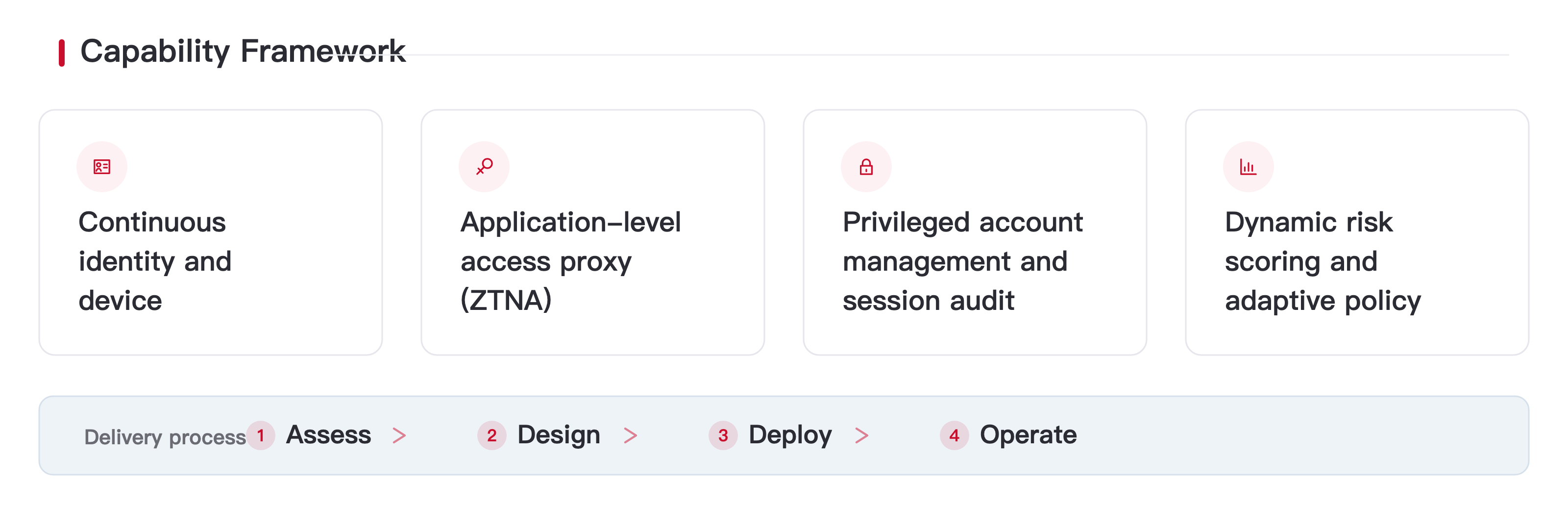
Zero trust replaces implicit trust and one-time verification with continuous verification. Check Point's path includes continuous identity and device assessment with MFA and dynamic risk scoring; application-level access proxies (ZTNA) that make applications invisible to unauthorised users and expose only the specific app rather than a subnet; and privileged account management with session recording for auditable high-privilege actions.
The usual failure mode is attempting a single massive transformation. A phased approach works better: map critical applications and data flows, bring the most sensitive systems under application-level control, extend to general business and third-party access, then unify policy across branches, cloud and mobile — each phase measured by lateral paths removed, privileged sessions governed and anomalous access blocked. GSAFE supports assessment, architecture and phased roadmaps.
Key capabilities
- Continuous identity and device verification
- Application-level access proxy (ZTNA)
- Privileged account management and session audit
- Dynamic risk scoring and adaptive policy